Case study · GoTo
From Failed Launch to Flagship
Challenge
Customer Engagement launched the week I joined. It had been built in three months on the assumption that "we know our customers," and almost nobody used it. Its positioning was unclear and its audience ran from small business to enterprise.
Action
Research showed we'd built the wrong thing. Customers needed one view of all their incoming contact, not outbound campaigns. We reframed CE into a CX platform. Then I pushed for the shift from a broad horizontal product to an industry vertical, automotive dealerships, and laid the groundwork myself long before it had a team.
Impact
CE became the foundation of Connect CX, GoTo's flagship. GoTo Connect for Automotive launched in Q3 2025 and beat its revenue goal for the year in its first quarter after launch, proving the vertical model for the business.
GoTo Connect for Automotive beat its revenue goal for the year in its first quarter after launch (work began Q4 2024; launched Q3 2025)
Measuredits success proved the vertical practice, and the business expanded it
FactCX went from missing its targets to contributing revenue
Directionalfrom failed launch to flagship foundation
Fact- Organization
- GoTo: Customer Engagement, which became Connect CX, and then GoTo Connect for Automotive
- Partnership
- Part of the UX, Product, and Engineering leadership trio. The automotive vertical was mine end to end, alongside a product partner I'd worked with at Cox Automotive.
- Team
- At first, just me. My researcher, designers, and the Insiders program came in once the work had traction.
- Timeframe
- From CE's launch in 2022, through the official start on automotive in Q4 2024, to GoTo Connect for Automotive's launch in Q3 2025 and its first-quarter results
The Challenge
Customer Engagement launched the week I started. It had been built in three months on the belief that "we know our customers" and "this isn't a research project." It reached market on time, and almost nobody used it.
The product had no clear positioning. Nobody could say whether it was standalone or an add-on to the platform. It had no defined users or workflows, and its audience was everyone from small business to enterprise. Sales were minimal, and the people who tried it didn't understand what it was for.
Underneath that was a deeper problem: it was solving the wrong one. We'd built for sending outbound text and email campaigns. What customers actually struggled with was keeping track of fragmented incoming communication across channels.
Mandate: How do we turn a product almost nobody uses into one customers can't do without, and then find the market where it wins first?
My Role
Owned
- The automotive vertical, end to end
- The automotive ecosystem map, initial personas, outcomes, and key metrics, before any designer or researcher was assigned
- Relationships with dealerships already using GoTo products, built from my first weeks through the CSMs
Led
- The research that reframed CE: Insiders discovery, usability, beta cohorts
- Dealership research: my own in Salt Lake City, plus the New York State trips I organized for me, a researcher, and my product partner
- Recruiting dealerships into testing and the Insiders program
- Moving the team from building first to discovery-led
Partnered on
- The business case and the push for approval, with my product partner
- Platform positioning for CX, with Product
- Roadmap and prioritization (UX, Product, and Engineering trio)
- Weekly metrics reviews against outcomes in Mixpanel
Approach
Act 1: Reframe the product (CE → CX)
Find out what customers actually needed. As soon as I had a researcher, we started talking to customers. That work became the Insiders program. It showed we'd been focused on the wrong job: customers needed one place to track every contact coming in, how it was segmented, and who had access to it.
Change the product's shape. We reframed CX around end-to-end customer communication journeys, and repositioned it as a platform with attachable capabilities rather than a standalone product with no clear home.
Narrow the audience. We defined personas, industries, and key workflows, so the product stopped trying to serve everyone from a solo business to an enterprise.
Change how the team worked. We moved from building first to discovery first. Product, UX, and Engineering aligned around customer workflows and measurable outcomes, and every major direction was validated through iterative research, usability testing, and beta cohorts before it scaled.
Act 2: Go vertical (automotive)
Research kept pointing the same way: industry-specific solutions were far more effective than generic features. I'd expected that, and started preparing long before there was approval to act on it.
Groundwork from week one. I knew automotive. I'd spent four years at Cox Automotive on Xtime and Dealertrack DMS, and had been doing automotive work since I was 16. When I started meeting CSMs, I also met the people who ran the dealerships already using GoTo products, and built those relationships because I knew we'd push for this eventually. Before any designer or researcher was assigned to it, I built the first automotive ecosystem map in Miro (how dealerships and dealer groups are structured), the initial personas, the outcomes, and the key metrics myself.
The dealership hierarchy shaped the product itself. Frontline staff used the communications every day. The reporting in the SKU was built for the people above them: owners, GMs, sales managers, and the fixed ops, service, and parts leads who needed to see how calls were routed, how long customers waited, how conversations went, and whether AI Receptionist was deflecting calls and booking appointments.
A partner who knew the territory. My product partner had worked with me at Cox Automotive. Together we built the case and kept pushing until the vertical got traction and approval. Work officially began in Q4 2024.
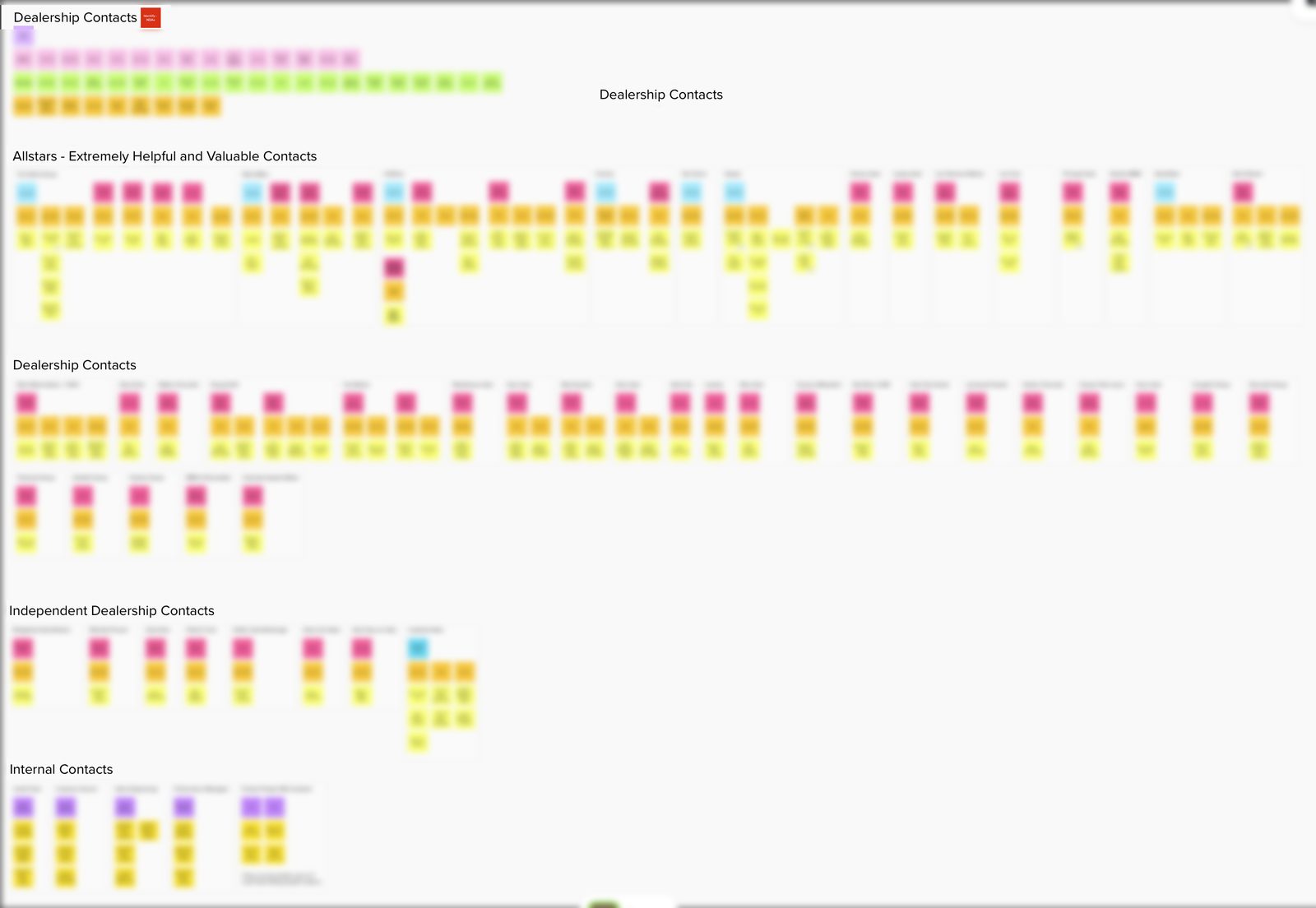
- Research in the dealerships. I did my own onsite research in Salt Lake City, and organized and scheduled trips to dealerships in New York State for me, a researcher, and my product partner. I recruited every dealership and brought them into testing and the Insiders program.
- Personas across sales, service, and administration, with end-to-end dealership workflows mapped to find friction and opportunity
- A key insight: dealership networks are highly interconnected, and the critical use cases were call deflection and appointment capture
- Validation through Insiders alpha and beta customers, iterating on continuous feedback
- What shipped: a dedicated automotive SKU, sold as its own package rather than an add-on. It launched with the critical reporting first, and grew into out-of-the-box reporting preferences for dealerships, among other things.
Key Artifact
Results & Impact
Business
- CE became the foundation of Connect CX, GoTo's flagship product, about three years after its failed launch.
- CX moved from missing its targets to contributing revenue once it was repositioned as a platform.
- GoTo Connect for Automotive launched in Q3 2025 and beat its revenue goal for the year in its first quarter after launch. Dealerships bought it outright, as its own package.
Strategy
- Automotive's success proved the vertical practice would work, and the business expanded it.
- The roadmap shifted from generic features toward industry-focused product strategy.
Organization
- The team moved from building first to discovery-led work, and Insiders became the standing source of validation for every vertical.
Reflection
What I learned
- Speed to market means nothing if you're fast at the wrong thing. CE shipped in three months and took three years to recover.
- A product for everyone is a product for no one. The vertical focus is what finally made CX legible to buyers.
- Domain knowledge lets you start before you're staffed. With no designer or researcher assigned, I could still build the ecosystem map, personas, outcomes, and metrics, so the team started from a foundation when it arrived.
What I'd do differently
On the CE side, the lesson is the one in the Insiders case study: insist on research from day one.
On automotive, I'd have been more aggressive before we had approval. I'd have put together a real plan earlier, covering the market, what would change, and what we could do, and pushed it sooner with my product partner. We worked closely, but we could have moved faster together.